Rainy Season, Active House: An Indoor Movement Plan That Works for Kids, Parents and Grandparents Together
When weeks of grey weather and cold rain eliminate outdoor activity, household movement habits collapse fastest — and the metabolic and mood consequences accumulate quickly across every family member. This multi-generational indoor movement plan requires no equipment and minimal space.

Exercise Physiologist & Active Lifestyle Coach · 9. 7. 2026 · 4 min čtení
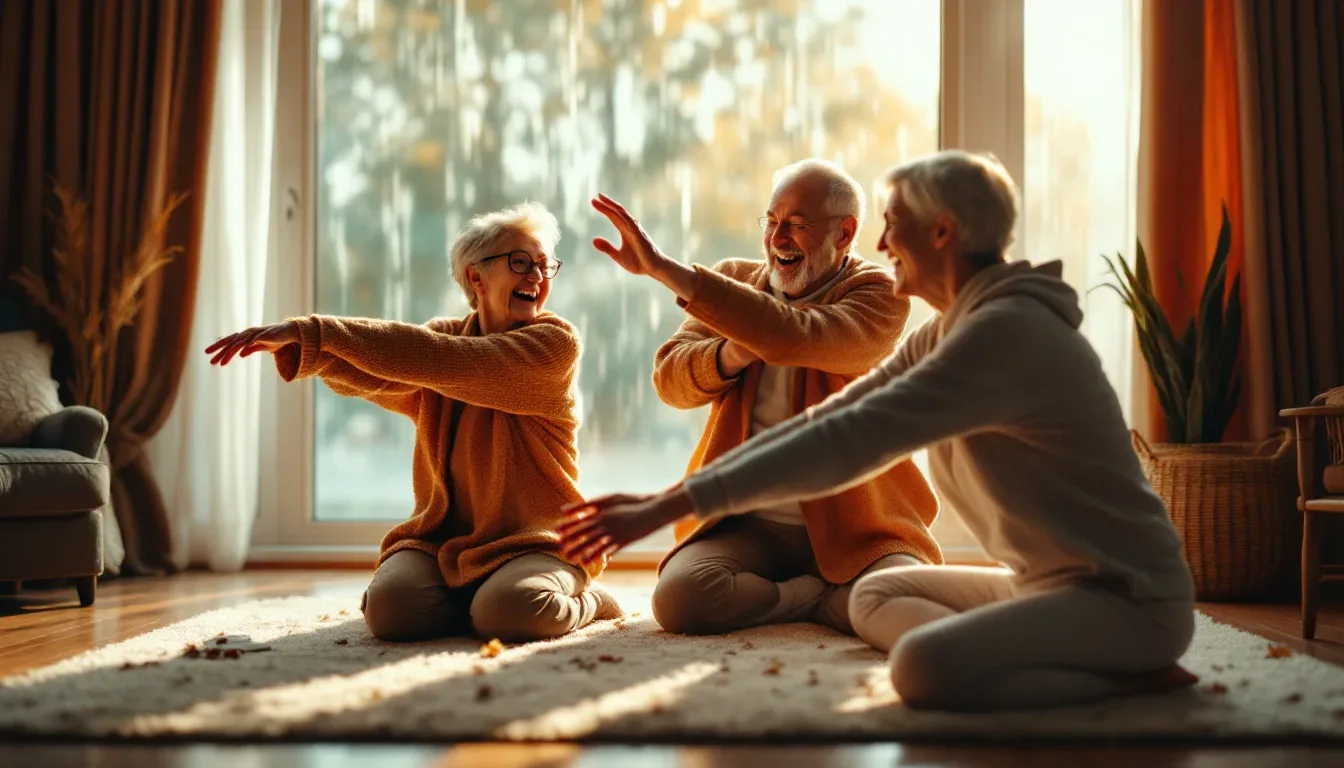
Three days of rain become five, five become ten, and somewhere between the second and third grey week, the family sofa quietly wins. Kids grow restless and irritable, parents feel sluggish after work, and grandparents stiffen up from sitting too long — all for exactly the same reason: the usual movement routines that depend on good weather have simply disappeared. The good news is that staying active indoors is genuinely doable, even in a small flat, even with three generations under one roof, and even without a single piece of gym equipment.
Why Rainy Weeks Hit Every Generation Differently — But Hit Them All
Children are the most visibly affected. Without an afternoon in the park or a walk to school, excess energy has nowhere to go, which tends to surface as mood swings, poor concentration, and trouble sleeping. For adults juggling remote work or long commutes, reduced movement compounds the effects of prolonged sitting — joints stiffen, energy dips in the afternoon, and the metabolic slowdown that comes with inactivity becomes noticeable within days. Older adults face perhaps the greatest risk: reduced daily steps, even over a short stretch, can meaningfully affect balance, joint mobility, and general well-being. The multi-generational household, which might seem like a logistical challenge, is actually an advantage — different generations can motivate each other in ways no app or fitness programme can replicate.
The Core Principle: Micro-Movement, Consistently Stacked
Forget the idea that indoor activity requires a dedicated hour-long session. Research consistently shows that shorter, frequent bouts of movement throughout the day are highly effective for maintaining metabolic function, mood, and mobility. The goal for rainy weeks is to stack small movement moments — five to fifteen minutes at a time — at natural transition points in the day: after breakfast, before lunch, mid-afternoon, and after dinner. This approach works across age groups because it removes the pressure of a formal workout and fits into real family life.
“Movement doesn’t need a gym — it needs a habit. And habits are easiest to build when the whole household is doing them together.”
Aim for a loose daily rhythm rather than a rigid schedule. On days when everyone is home, three to four short sessions add up to meaningful activity without disrupting work, school, or rest.
A Room-by-Room Activity Toolkit
You don’t need a dedicated space. Every room in the house offers movement opportunities if you look at it with fresh eyes.
Living Room
- Dance breaks: Put on a favourite playlist and move freely for five minutes. Children lead, grandparents modify — swaying and arm movements count fully.
- Sofa-free floor time: Designate one session per day where everyone sits on the floor — this alone challenges core stability and hip mobility in ways chairs never do.
- Balance challenges: Standing on one foot while waiting for the kettle, or doing slow heel-raises during a TV commercial break, require no space at all.
- Cushion obstacle course: For younger children, a cushion-and-pillow obstacle course burns genuine energy and builds coordination.
Hallway and Stairs
- Stair laps: Walking up and down stairs deliberately — not just as transit — is one of the most effective cardiovascular and leg-strengthening activities available in any home. Even five minutes of stair walking is substantial.
- Hallway walking circuits: In a longer hallway, back-and-forth walking with varying pace gives older family members safe, joint-friendly cardio.
Kitchen
- Counter push-ups: Hands on the counter edge, inclined push-ups — safe and effective for adults and older children, easily modified for grandparents.
- Calf raises while cooking: Standing on tiptoes repeatedly while stirring or waiting is a small habit with real cumulative benefit for circulation and lower-leg strength.
A Simple Multi-Generational Movement Plan
Below is a practical weekly framework. Treat it as a menu, not a mandate — pick what works on any given day and let the family vote on activities when possible. Children are far more likely to participate enthusiastically if they feel some ownership over the choices.
- Morning Stretch Circle (10 min): Everyone gathers in the living room for gentle full-body stretching. Grandparents lead — they often know their bodies best and it gives them a meaningful role. Focus on neck rolls, shoulder circles, seated forward folds, and ankle rotations.
- Midday Energy Break (10–15 min): A short burst of higher-intensity movement — dancing, stair laps, or a simple indoor circuit of jumping jacks, squats, and arm swings. Children set the pace; adults and grandparents modify as needed.
- Afternoon Game Session (15–20 min): Structured movement games: Simon Says (using only physical actions), freeze dance, or a slow-motion sports pantomime where everyone mimes their favourite sport in slow motion. These are genuinely fun across all ages.
- Post-Dinner Walk Indoors (10 min): A calm, low-intensity wind-down walk — laps of the flat or up and down the hallway. This aids digestion, supports better sleep, and creates a natural evening transition ritual.
Keeping It Sustainable When Motivation Drops
The second week of rain is always harder than the first. Motivation naturally wanes, and this is completely normal. A few practical strategies help bridge the gap between intention and action:
- Keep a simple paper chart on the fridge where each family member marks completed movement sessions. Visual progress is a surprisingly powerful motivator for all ages.
- Rotate who chooses the activity each day — children will look forward to their turn and grandparents often surprise everyone with creative suggestions.
- Lower the bar on difficult days. Even five minutes of stretching is better than nothing and preserves the habit structure.
- Acknowledge effort loudly and specifically. “Grandma held that balance for a whole minute” lands better than generic praise.
- Tie movement sessions to existing anchors — always after breakfast, always during the ad break — rather than leaving them floating in the diary.
A Note on Comfort, Safety, and Appropriate Intensity
Multi-generational movement only works if every participant feels safe and comfortable. Older adults should always have a stable support nearby — a chair back or wall — for any standing balance exercise. Children should be reminded that this is playful activity, not competition, so frustration stays low. For adults with existing joint issues, replacing any jumping movements with walking in place or slow squats is a straightforward swap. The rule across all ages: mild breathlessness is fine; pain, dizziness, or sharp discomfort means stop and rest.
Časté dotazy
What if our flat is very small — can this really work in a tight space?
Yes, genuinely. Most of the activities described require nothing more than the space of a yoga mat, roughly 60 x 180 cm. Stair walking needs a staircase — and for those in single-floor flats, hallway laps, in-place marching, and floor exercises cover the same ground effectively. The movement plan is deliberately designed for ordinary homes, not open-plan fitness spaces.
How do we get reluctant grandparents involved without making them feel pressured?
Give them a role, not just an invitation. Asking a grandparent to lead the morning stretch or to teach the children a traditional game or dance they remember from their own childhood immediately shifts the dynamic from participation to leadership. Most reluctance dissolves when there’s genuine purpose and no sense of performance anxiety.
Is this enough to maintain fitness during a long rainy stretch of several weeks?
For maintaining baseline mobility, mood, metabolism, and general energy levels — yes, a consistent indoor movement plan like this is meaningfully effective. It won’t replace intensive sport-specific training, but that’s not its purpose. The goal during rainy weeks is to preserve habits, keep the body moving daily, and prevent the rapid deconditioning that comes from extended inactivity. When the weather clears, the family that kept moving indoors will find returning to outdoor activity far easier than one that stopped entirely.
Tom specializes in designing movement habits that stick for entire households, drawing on Scandinavian active-living principles and exercise physiology research. He is passionate about turning everyday chores and family outings into genuine fitness opportunities.