The Invisible Snacking Patterns Inside Most Households (And How to Spot Yours Before They Become Routine)
Households develop collective snacking habits that no single family member consciously chose — from the open biscuit tin by the kettle to the pre-dinner grazing ritual — and they quietly undermine individual weight management without anyone noticing. A family-level awareness audit can change these patterns faster than individual willpower.

Registered Dietitian & Seasonal Nutrition Specialist · 11. 7. 2026 · 6 min čtení
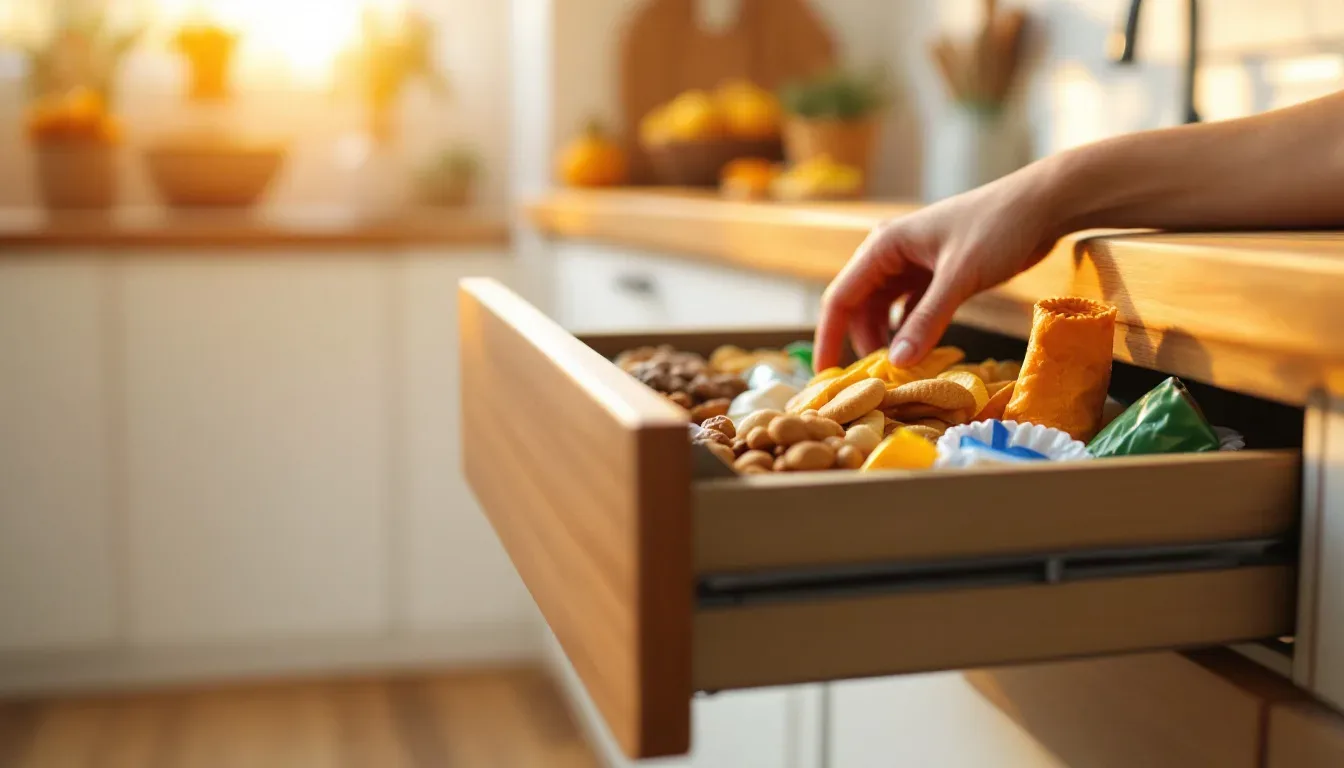
Nobody sits down and decides that their household will eat half a packet of crackers every evening while watching television. And yet, in most homes, that is precisely what happens — quietly, gradually, and without anyone ever making a conscious choice. Collective snacking patterns are among the most overlooked forces shaping how families eat, and because they develop slowly, they rarely trigger the alarm bells that an obviously unhealthy decision would. By the time anyone notices, the open biscuit tin by the kettle has become as unremarkable as the kettle itself.
How Household Snacking Patterns Form (Without Anyone Deciding)
Shared living spaces create shared habits almost automatically. When one person reaches for something to nibble on while waiting for the coffee to brew, others observe and eventually mirror the behaviour. Over weeks and months, these small acts solidify into rituals — not because the family agreed to them, but because humans are deeply social creatures who synchronise their behaviour with the people around them.
The kitchen layout plays a surprisingly large role. A fruit bowl that requires a deliberate decision to open the fridge is used very differently from a bowl of mixed nuts sitting open on the counter. Proximity, visibility and ease of access are the real decision-makers in most households, long before hunger or appetite even register.
Common pattern triggers include boredom during school homework time, the gap between arriving home and dinner being ready, the collective winding-down after a busy day, and weekend mornings when the structure of a weekday disappears entirely. None of these triggers are problematic on their own, but they become significant when each one is reliably paired with a particular food.
The Six Most Common Invisible Snacking Patterns
Before you can change a pattern, you need to see it clearly. These are the configurations that appear most frequently in family households:
- The Kettle Station: Whatever sits beside the kettle gets eaten. Biscuits, cereal bars, a bowl of crisps — they disappear steadily throughout the day, one small portion at a time, by every person who makes a drink.
- Pre-dinner grazing: The thirty to sixty minutes before the evening meal is prepared becomes an informal snacking window, often driven by hunger but reinforced by whoever is cooking also tasting, reaching, and nibbling.
- The children’s leftovers loop: Parents finish what children leave on their plates — a half-eaten banana, the last few chips — without registering it as eating at all.
- The screen-time snack reflex: Food appears automatically when the television goes on. The two activities become neurologically linked, so sitting down to watch something triggers hunger (or at least the urge to eat) even when no one is actually hungry.
- Weekend morning drift: Saturday and Sunday mornings lack the structure of weekdays, and the kitchen becomes a passing-through space where everyone helps themselves at different times across a two or three-hour window.
- The stress-triggered pantry visit: When the household atmosphere becomes tense — an argument, a difficult phone call, exam stress — multiple family members independently open the cupboard within minutes of each other.
Why Individual Willpower Rarely Solves a Household Problem
The standard advice — eat more mindfully, resist temptation, make better choices — is directed at the individual. But if the environment around that individual remains unchanged, the friction required to act differently is enormous and unsustainable. One person trying to skip the pre-dinner graze while everyone else is doing it is working against both the physical cue (the food is there) and the social cue (this is what we do together at this time).
The most effective dietary change is rarely the one that requires the most self-discipline. It is the one that quietly redesigns the environment so the default option becomes the better option.
This is why a family-level awareness audit — where the household as a unit examines its own patterns — tends to produce faster, more durable results than any individual trying to modify their behaviour against the grain of the home’s collective rhythm.
Running a Simple Family Awareness Audit
An awareness audit does not require a nutritionist or a complicated tracking system. It simply involves making the invisible visible for a defined period — typically one week.
Step 1: Map the snacking geography
Walk through your home and note every location where food is accessible outside of mealtimes. The counter, the fruit bowl, the bedside drawer, the car cupholder, the desk. Ask yourself: is this here because someone consciously put it here, or did it just accumulate?
Step 2: Identify the trigger moments
For seven days, every time someone in the household eats outside of a planned meal, note the time, the location, who was present, and what preceded it (boredom, transition between activities, a specific person’s arrival home). Patterns will emerge quickly.
Step 3: Discuss as a family, not as individual problem-owners
Frame the conversation around the household’s patterns, not individual habits. “We tend to graze before dinner” lands very differently from “you always eat biscuits at four o’clock.” Shared ownership of the pattern leads to shared motivation to shift it.
Practical Adjustments That Actually Stick
Once patterns are identified, small structural changes consistently outperform big motivational drives. Consider these:
- Move the biscuit tin off the counter and into a cupboard that requires deliberate opening. This single change, done consistently, reduces automatic grabbing significantly.
- Introduce a defined pre-dinner snack — something intentional, portioned, and eaten sitting down — rather than leaving the pre-dinner window as an open grazing period.
- Replace counter-level visibility with a fruit bowl that is genuinely appealing and replenished regularly. The key is making the accessible option a reasonable one.
- Create a brief kitchen-closing ritual after dinner — tidying, switching off the light — that signals to everyone that the eating day has ended.
- On weekends, agree on a shared breakfast time, even a relaxed one. Structure does not have to be rigid to be useful.
- Keep a small bowl of something like cherry tomatoes, carrot sticks or edamame near the cooking area for the cook and anyone nearby to use during meal preparation — it replaces unconscious grazing with a deliberate, lighter alternative.
What to Expect When You Start Changing the Pattern
The first few days of any environmental change will feel odd. Family members will reach for the biscuit tin and find it has moved, or sit down for television and notice there is nothing on the table. This friction is not failure — it is evidence that the old cue is being disrupted. The discomfort typically passes within a week or two as new defaults replace old ones. The goal is not perfection or restriction; it is awareness and intentionality. Most families find that simply naming the patterns out loud together reduces their hold considerably, even before a single tin has been moved.
Časté dotazy
Do I need to ban snacking altogether to make a difference?
Not at all. The goal is not to eliminate snacking but to make it conscious rather than automatic. Planned, intentional snacks that fit into the rhythm of the day are entirely compatible with healthy weight management. It is the unnoticed, routine, triggered snacking — the handful grabbed while passing the counter — that tends to add up without anyone realising.
What if only one person in the household wants to change?
One motivated person can shift quite a lot by quietly adjusting the environment rather than making demands. Moving less helpful foods out of sight, placing better options where the tin used to be, and changing your own visible behaviour around snacking all influence the household environment without requiring a family-wide agreement. Over time, others often follow without ever having had a formal conversation about it.
How do I handle this with children without making food a source of conflict?
Keep the tone curious and practical rather than restrictive. Involving children in the audit — letting them spot the patterns too — turns it into something interesting rather than a rule imposed on them. Framing changes as “let’s try something different this week” rather than “we are not allowed to do that anymore” preserves the relaxed relationship with food that is important for children to develop. Consistent structure, calm role-modelling and genuinely available alternatives matter far more than enforcement.
Claire has spent over a decade helping families redesign their kitchens and meal rhythms around seasonal produce and metabolic science. She believes that eating with the calendar is one of the most underrated health tools available.